This website contains content related to firearm components and building tools. Access is strictly limited to persons of legal age according to their jurisdiction. By entering this site, you affirm and certify the following:
1. I am at least 18 years old for long gun components 2. I am at least 21 years old for handgun components 3. I am NOT a prohibited person under federal law (18 U.S.C. § 922(g)) 4. I am in a jurisdiction where accessing this content is legal 5. I understand that misrepresentation may constitute a crime
The sights that come on most pistols are fine for confirming your point of aim in a well-lit shooting lane. Under any other condition — low light, close quarters, real stress — they’re the weak link in the system. If you’re building a Polymer80 pistol and putting thought into every other component, the sights deserve the same consideration.
I’ve run a lot of different setups across carry guns, competition builds, and home defense configurations. What I’ve learned is that there’s no universal answer, but there’s almost always a clear right answer once you know what the pistol’s job is. Let me walk you through the main categories, what they actually deliver, and how to match sights to your build’s purpose.
Table of Contents
First: Why Stock Pistol Sights Almost Always Get Replaced
Factory Glock sights are polymer. That’s not an exaggeration — they’re injection-molded plastic with a white outline painted on. They’re a cost-reduction measure on a production pistol, and they show it. The rear sight face reflects light in ways that wash out contrast at the worst moments. They wear faster than steel, they can’t hold zero as well under recoil over time, and they offer no low-light capability whatsoever.
On a custom Polymer80 build, you’re already upgrading the frame, the trigger, and probably the slide. Leaving factory-spec polymer sights on that build is like putting all-season tires on a sports car. The first upgrade most experienced builders make is sights, and it’s money consistently well spent.
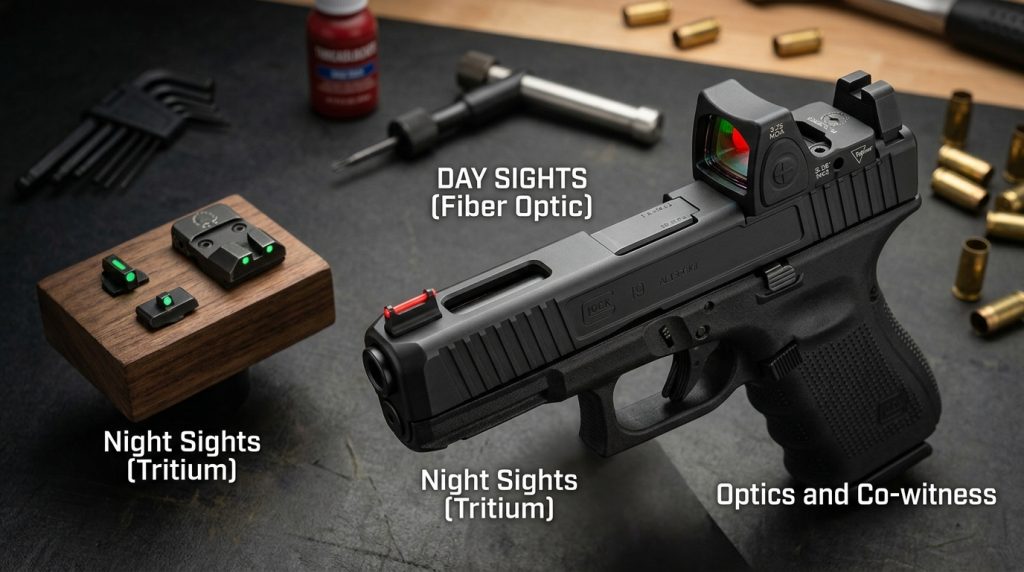
The three categories you’re choosing between are fiber optic irons, tritium night sights, and red dot optics. Each has a distinct purpose and a distinct trade-off. Here’s the real breakdown.
◉ Fiber Optic Sights — Competition and high-visibility range work
✓ Extremely fast sight acquisition in good lighting
✓ Bright front post draws the eye naturally under stress
✓ Affordable compared to tritium or optics
✓ Excellent for competition builds where matches run in daylight
✖ Zero low-light capability — fiber goes dark with the light
✖ Fiber rods can break under hard use or extreme temperature swings
✖ Not the right choice for a carry or home defense build
Best for: Competition, range training, daytime use only — not suitable as your only sight on a defensive build
● Tritium Night Sights — The most versatile defensive sight option
✓ Glow in the dark without batteries or light — radioactive tritium vials do the work
✓ XS Big Dot design gives an extremely fast front sight in low light
✓ Steel construction — durable enough for serious carry use
✓ Works in daylight and darkness equally well
✓ No electronics to fail, no battery to check
✖ Tritium vials dim over time — most manufacturers rate them at 12 years
✖ Precise long-range shooting is harder with a large front dot design
✖ More expensive than basic iron sights
Best for: Concealed carry, home defense, duty use — the most practical all-condition defensive sight
■ Red Dot Optics (RDS) — The fastest, most versatile sight system available
✓ Single focal plane — no front/rear sight alignment needed
✓ Works in any light condition with auto-brightness or manual adjustment
✓ Faster target acquisition than any iron sight under stress
✓ Parallax-free at defensive distances — point where the dot is, that’s where it hits
✓ Accommodates shooters with vision challenges better than irons
✖ Requires an optics-cut slide — extra cost or pre-spec your build
✖ Battery dependency — carry a spare and track replacement interval
✖ Adds height over bore — requires adjustment to shooting mechanics
✖ Quality options start at $200 and the good ones cost considerably more
Best for: Competition, home defense, range builds — the right answer if your slide has an optics cut and you’re willing to invest in training with it
Matching Your Sights to Your Build’s Purpose
Concealed Carry
Tritium night sights are the default correct answer for carry. The XS Big Dot Tritium sight — available at polymer80firearms.com — is one of the most field-proven defensive sight systems in the industry. The large front dot is fast under stress, the tritium insert is bright enough to be usable in complete darkness, and the rear sight has a shallow V-notch that doesn’t snag on a draw. It’s not the most precise sight picture in the world, but precision at 25 yards is not what a carry gun’s sights need to be optimized for. Speed and visibility under pressure are, and Big Dots deliver both.
Red dots on carry guns are becoming more common and there’s a real argument for them — faster acquisition, better low-light performance than even tritium irons. The practical barriers are cost (a quality carry-grade RDS adds $200–$600 to your build), the need for an optics-cut slide, and the training required to draw and find a dot under stress. If you invest in that training, an RDS on a carry gun is excellent. If you don’t, the dot disappears when your pulse is elevated and you default to irons you don’t have.
If you’re running a red dot on a carry or home defense build, fit co-witness backup iron sights. Electronics fail at the worst moments. XS makes tritium co-witness irons that pair well with most common RDS heights.
Home Defense
Home defense scenarios almost by definition happen in reduced light. Fiber optics are out — they need ambient light to work. The choice here is between quality tritium irons and a red dot on an optics-cut slide. Either works well. Tritium irons require no battery management and no electronics to fail. A red dot gives you a faster, more intuitive sight picture in a dark hallway. My preference for a dedicated home defense build is a Holosun 507C with co-witness tritium backups — the Holosun’s Solar Failsafe keeps the dot running even with a dead battery, which removes the primary objection to red dots in a defensive context.
Competition
Fiber optics or a red dot, full stop. In competition you’re shooting in daylight, you want the fastest possible acquisition, and you’re changing positions and targets constantly. A bright fiber optic front sight like a Dawson Precision or Warren Tactical is perfectly dialed for that job at low cost. If you’re shooting Production or Limited divisions and a red dot is legal in your division, run one — the acquisition speed advantage is real and measurable over a season of matches.
Installation: Easier Than Most People Expect
Most Glock-compatible sights install with a sight pusher tool or a brass punch and a rubber mallet. The rear sight drifts out of its dovetail from right to left (when facing the rear of the slide), new rear goes in from the left, and the front sight threads into the slide with a 3/16″ hex bit on most configurations. The full installation on a standard iron sight swap takes about fifteen minutes with the right tool.
A sight pusher is worth owning if you’re doing multiple builds — it costs $30–$60 and prevents the drift marks and scratched finish that come from using a punch and hammer without a guide. It’s not required, but it’s the better approach.
Red dot installation requires following the manufacturer’s torque spec on the mounting screws — typically 15–18 in-lbs. Use thread locker on the screws. A dot that walks under recoil because the mount wasn’t torqued correctly is a problem that ruins a range session and can cost you in a defensive situation.
Budget Reference by Sight Type
Sight Type / Product
Price Range
Best Use Case
Factory Glock polymer sights
Free (stock)
Replace immediately — they’re a placeholder
Basic steel 3-dot irons
$25–$50
Budget range build; not for carry or home defense
XS Big Dot Tritium (from polymer80firearms.com)
$90–$115
Carry, home defense, low-light — best value night sight
Trijicon HD XR Night Sights
$110–$140
Carry and duty — precision + night capability combined
Fiber optic competition sights
$60–$120
Range, competition — fast in daylight
Holosun 507C / 407C red dot
$200–$260
All-purpose — carry, competition, home defense
Trijicon RMR Type 2
$500–$600
Serious duty / carry — near-indestructible
Co-witness irons (for RDS builds)
$60–$140
Backup sights for optics-cut slide builds
The Short Version
Carry gun: XS Big Dot Tritium or comparable tritium front post with a blacked-out rear. Home defense: tritium irons or Holosun 507C with co-witness backup. Competition and range: fiber optics in daylight, red dot if your division allows it. Don’t leave factory polymer sights on a build you care about. The upgrade takes 15 minutes and makes the pistol work like the defensive tool it’s meant to be.
Browse XS Big Dot Tritium sights, red dot optics, co-witness irons, and sight installation tools at polymer80firearms.com — alongside everything else you need to complete your Polymer80 build.