This website contains content related to firearm components and building tools. Access is strictly limited to persons of legal age according to their jurisdiction. By entering this site, you affirm and certify the following:
1. I am at least 18 years old for long gun components 2. I am at least 21 years old for handgun components 3. I am NOT a prohibited person under federal law (18 U.S.C. § 922(g)) 4. I am in a jurisdiction where accessing this content is legal 5. I understand that misrepresentation may constitute a crime
SIG Sauer makes excellent pistols. They also have a parts and accessories ecosystem that can be genuinely confusing to navigate — especially across the P320 and P365 platforms, where the modular design creates almost unlimited configuration options, and where the line between what SIG intends and what the aftermarket has invented gets blurry fast.
I’ve worked on both platforms extensively. The P320 in particular has become a platform I spend a lot of time with, partly because of the military adoption but mostly because the FCU-centric modular design makes it one of the most customizable striker-fired pistols available without any tooling. The P365 is a different animal — purpose-built for concealment, less modular by design, but still with meaningful upgrade potential. Here’s what I’ve learned about what’s actually worth doing on each platform.
Table of Contents
Understanding What Makes SIG Sauer Different: The FCU
Before talking parts, it’s worth understanding the one thing that separates the P320 from almost every other pistol on the market: the Fire Control Unit. The FCU is the serialized component in a P320 — the part that is legally the firearm. It’s a self-contained chassis that houses the trigger group, and it drops into different grip modules and slides depending on the configuration you want.
This matters for parts discussions because it changes what ‘building’ a SIG means. You’re not completing a frame the way you do with a Polymer80 pistol. You’re configuring a modular platform — swapping grip modules, slides, and barrels around a central serialized FCU. The upgrade philosophy is different, and understanding that from the start saves you from buying the wrong things in the wrong order.
The P365 doesn’t use the same FCU system in the same way — it’s a more conventional design, smaller, and the parts ecosystem reflects a carry-focused platform rather than a modular service pistol. Upgrades exist, but the range is narrower by design.
On the P320: the FCU is the firearm. Everything else — grip module, slide, barrel — is an accessory in the legal sense. Plan your build around the FCU first.
P320: The Parts Worth Your Money
Trigger: The Highest-Impact Upgrade on the Platform
The factory P320 trigger is decent. It’s not outstanding. The reset is longer than it needs to be and the pull weight on most factory configurations is heavier than what experienced shooters prefer for precision work. This is the first thing most P320 owners upgrade, and for good reason — a better trigger transforms how the pistol feels to shoot.
Grayguns is the name that comes up most consistently in P320 trigger conversations, and their reputation is earned. Their P-SAIT (Straight Anatomy Interface Trigger) and performance carry triggers address both the geometry and the mechanics of the stock trigger in ways that produce a meaningfully cleaner break and shorter reset. They’re not cheap, but they’re not a gimmick either. Flat trigger shoes from other manufacturers like Apex Tactical are also strong options at various price points and are widely compatible with stock P320 internals.
One compatibility note: early P320s and post-voluntary upgrade P320s have different internal geometries. Confirm your FCU’s production era before ordering trigger components — most reputable manufacturers specify compatibility on their product listings.
Grip Module: More Than Aesthetics
The grip module is where the P320’s modularity really pays off. SIG’s own lineup covers compact, full-size, carry, and X-series configurations, and third-party manufacturers like Grayguns, Recover Tactical, and Wilson Combat have added options that improve ergonomics, add texture, or optimize the grip for specific use cases.
SIG OEM grip modules are the safe choice — they’re designed to spec, fit every FCU without guesswork, and the X-series versions include a longer dust cover that accommodates lights and lasers without an adapter. Where aftermarket grips earn their place is in ergonomic refinement: better texture, steeper or shallower grip angles, or configurations that a particular shooter’s hand geometry fits better than any stock option. Wilson Combat’s grip modules in particular have earned consistent praise for build quality and feel.
One thing to watch: some aggressive aftermarket grip textures will destroy the inside of a kydex holster faster than normal wear. If you’re running the pistol in a holster daily, check whether your holster manufacturer has addressed this in their design.
Sights: Never Leave the Factory Irons On
SIG’s factory sights on most P320 configurations are functional but basic. The three-dot setup isn’t bad, but if you’re putting any round count through this pistol, upgrading the sights should be high on the list — either to quality night sights or to a slide configuration that supports a red dot.
For iron sights, TRUGLO, XS Sights, and Trijicon all make P320-compatible options with different front sight profiles. XS Big Dot sights in particular have a devoted following among defensive carry shooters for their speed in low-light acquisition. They give up some precision at distance but gain significantly in close-range speed — a trade-off that makes sense for carry applications.
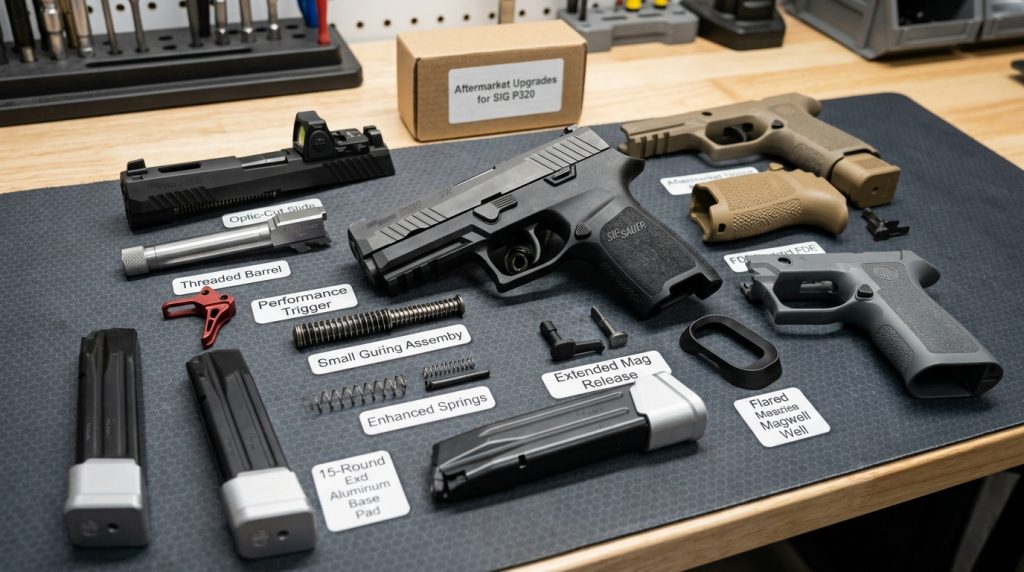
For red dots, the P320 X-series slides come optics-cut from the factory. If you’re on an older non-optics-cut slide, SIG offers factory optics-cut slides as OEM replacements, and aftermarket options are available through polymer80firearms.com for builders who want to spec out the full slide separately. A Holosun 507C or 407C is the most common pairing at the practical price tier.
P365: Carry-Focused, Upgrade Deliberately
The P365 is a smaller, less modular platform, and the upgrade approach reflects that. Most P365 owners have it as a carry gun, which means the priority list is different: reliability matters above all else, and any upgrade that introduces uncertainty into that reliability needs to be vetted carefully before it goes into a carry pistol.
The upgrades that consistently add value on the P365 without introducing risk are sights and the trigger. The factory trigger on the P365 has improved over production generations but is still softer and less defined than most experienced shooters prefer. Apex Tactical makes a P365-specific flat-faced trigger that’s one of the cleanest drop-in options available — it shortens reset and improves the break without requiring any internal modification. Night sights from Trijicon or XS Sights are the other high-value upgrade, and neither involves any compatibility risk.
Where P365 owners sometimes get into trouble is with aggressive aftermarket barrel changes or extended magazine releases that haven’t been properly tested in their specific production variant. The P365’s design is tighter than the P320, and tolerances matter more. Stick to established manufacturers with P365-specific products — not adapted P320 components — for anything that goes inside the action.
P365 rule of thumb: if you can’t find documented user reviews specific to your P365 variant for a given upgrade, that’s a sign to wait for more data before running it in a carry gun.
OEM vs. Aftermarket: When to Use Which
The honest answer is that SIG OEM parts are excellent and the aftermarket adds value in specific places — not everywhere. SIG’s internal components, recoil spring assemblies, and frame-critical parts are well-engineered and manufactured to tight tolerances. Replacing those with aftermarket versions for the sake of it rarely improves anything and occasionally degrades reliability.
Where aftermarket wins: triggers, sights, grip modules (ergonomics), and slides with better optics cuts than what shipped from the factory. Those are the areas where aftermarket manufacturers have taken the platform somewhere SIG didn’t go from the factory, and the results are meaningful. Polymer80firearms.com carries SIG-compatible slides, barrels, and sight options across both platforms for builders who want to spec out configurations that aren’t available in the standard SIG lineup.
Parts Reference by Platform
Part
Platform
OEM or Aftermarket
Priority Level
Fire control unit (FCU)
P320
Either — match to use case
High
Flat trigger shoe
P320 / P365
Aftermarket (Grayguns, etc.)
High
Grip module
P320
OEM or aftermarket
Medium–High
Sights (night / fiber)
P320 / P365
Aftermarket strongly preferred
High
Optics cut slide
P320
OEM or aftermarket
High if running RDS
Barrel (threaded / match)
P320 / P365
Aftermarket for upgrades
Medium
Recoil spring assembly
P320 / P365
OEM recommended
Low (replace when worn)
Extended mag release
P320 / P365
Aftermarket preference
Low–Medium
What a Complete SIG Build Looks Like
Complete Build Snapshot: P320 Carry / Home Defense Build
• SIG P320 FCU (serialized — purchased through FFL)
• SIG OEM or Wilson Combat compact grip module
• Optics-cut slide — OEM X-series or aftermarket equivalent
• Match-grade or OEM threaded barrel (compact length)
• Grayguns or Apex flat trigger with performance spring kit
• Holosun 507C or Trijicon RMR (optics-cut dependent)
• OEM recoil spring — no aftermarket substitution recommended
• Quality IWB holster with proper retention for upgraded grip
The Bottom Line
SIG platforms reward deliberate, informed upgrades and punish random part swapping. The P320’s modularity makes it one of the most configurable pistols available, but that flexibility means you need a clear picture of what you’re building before you start ordering. The P365 is more constrained by design — carry-focused, reliability-first, upgrade carefully.
In both cases: start with sights and trigger, confirm compatibility before ordering anything internal, and use OEM parts for anything structural unless there’s a clear and well-documented reason to go aftermarket.
Browse SIG-compatible slides, barrels, sights, and build components for both the P320 and P365 at polymer80firearms.com. All serialized SIG components require FFL transfer — our team can walk you through the process if it’s your first online firearm purchase.