This website contains content related to firearm components and building tools. Access is strictly limited to persons of legal age according to their jurisdiction. By entering this site, you affirm and certify the following:
1. I am at least 18 years old for long gun components 2. I am at least 21 years old for handgun components 3. I am NOT a prohibited person under federal law (18 U.S.C. § 922(g)) 4. I am in a jurisdiction where accessing this content is legal 5. I understand that misrepresentation may constitute a crime
If you’ve spent any time researching Polymer80 frames online, you’ve probably run into a lot of conflicting information. Some of it’s outdated. Some of it’s written by people who don’t understand the regulatory history. Some of it’s just noise from corners of the internet where accuracy isn’t the priority.
Table of Contents
This article is going to give you a clear, factual picture of where things stand today — where they came from, what changed, and what you need to do as a buyer to stay fully compliant. It’s not legal advice, and if you have specific questions about your state’s laws, talking to an attorney who knows firearms regulations in your jurisdiction is always a reasonable step. But the federal picture is well-documented, and there’s no reason it should be confusing.
How We Got Here: A Brief History of Home Builds and ATF Oversight
The legal foundation for home firearm manufacturing in the United States has been in place since 1986, when the Firearm Owners Protection Act codified the right of private individuals to build firearms for personal use — provided they were federally eligible to own a firearm, not making the gun for sale, and complying with applicable state laws. This wasn’t a loophole; it was a recognized, established practice.
For years, companies like Polymer80 operated in that space by selling frames that were described as roughly 80% complete from the factory. The buyer would perform the final machining steps — drilling pin holes, clearing the fire control cavity — and then install the parts kit themselves. Under ATF interpretation at the time, these products were not yet classified as firearms at the point of sale, which meant they didn’t require an FFL transfer or background check.
That interpretation worked legally, but it attracted scrutiny. Law enforcement agencies raised concerns about untraceable firearms. The ATF began signaling that its regulatory approach would be revisited. And in 2022, two significant developments changed the landscape in ways that matter to anyone buying a Polymer80 frame today.
What Changed in 2022: Bruen and ATF Rule 2021R-05F
In June 2022, the Supreme Court issued its decision in New York State Rifle & Pistol Association v. Bruen. The ruling established a new standard for evaluating Second Amendment challenges — requiring that firearm regulations be grounded in the historical tradition of gun regulation in America. Bruen didn’t directly address 80% frames, but it reshaped how courts would assess firearms laws going forward and strengthened constitutional protections for gun owners in significant ways.
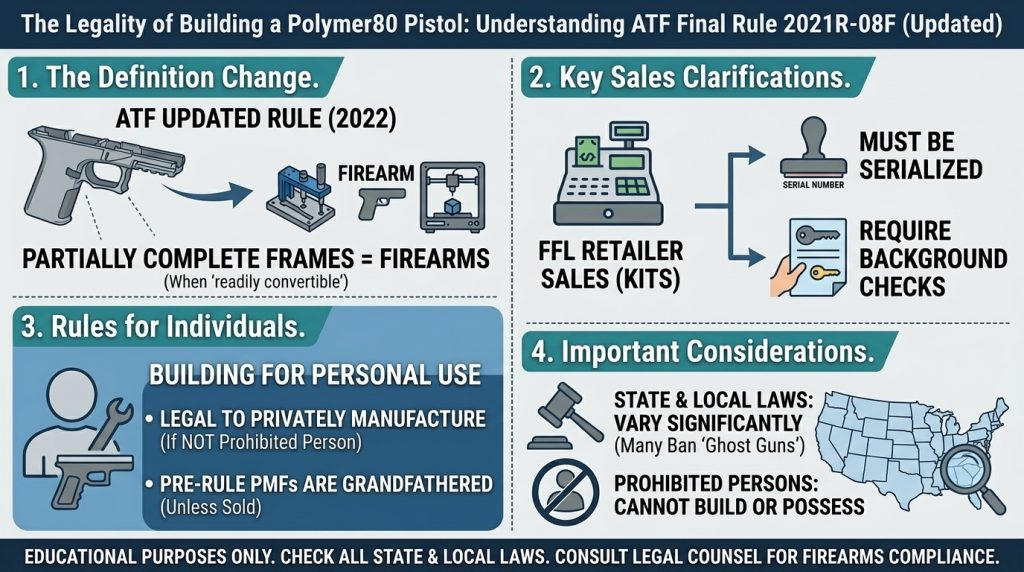
The more directly relevant development for Polymer80 buyers was ATF Final Rule 2021R-05F, which took effect in August 2022. This rule redefined what counts as a ‘firearm’ under the Gun Control Act in important ways:
Unfinished frames and receivers sold with the parts, instructions, or tools needed to complete them were reclassified as firearms at the point of sale.
This meant they became subject to the same federal requirements as any other handgun — serialization, FFL dealer transfer, and a federal background check via Form 4473.
The practical effect: the unserialized, direct-to-consumer 80% frame market that had existed for years was effectively ended for commercial sellers.
The rule was legally challenged almost immediately, and litigation around various aspects of it continues to work through the courts. Bruen’s framework has already been used to scrutinize parts of 2021R-05F at the district and appellate levels. The regulatory picture may continue to evolve.
That said, as of today, the rule is in effect for commercial sales. And reputable dealers like polymer80firearms.com have adapted accordingly — not reluctantly, but because operating with full compliance is simply the right way to run a business that serves responsible gun owners.
Note on ongoing litigation: Because this area of law is still being litigated, what’s written here reflects the current regulatory environment. The legal landscape around these rules may shift. Staying informed through reputable firearms law resources is always worthwhile.
The Regulatory Timeline at a Glance
Year
Event
What It Meant
1986
Firearm Owners Protection Act
Established that individuals may manufacture firearms for personal use. The legal foundation for home builds.
2013
Polymer80 Founded
Company launches in Nevada, selling Glock-compatible pistol frames to the DIY build community.
Pre-2022
80% frames widely available
Unserialized frames sold without FFL transfer. Legal under then-current ATF interpretation, controversial in practice.
June 2022
NYSRPA v. Bruen (Supreme Court)
Landmark Second Amendment ruling. Changed how courts evaluate gun regulations — stricter scrutiny required for future restrictions.
Aug 2022
ATF Final Rule 2021R-05F
ATF redefined ‘firearm’ to include unfinished frames and receivers sold with jig kits. Required serialization and point-of-sale regulation.
Post-2022
Serialized frames standard
Polymer80 adapts. All frames sold through authorized dealers now serialized, FFL-transferred, and background-checked — same as factory guns.
Today
Compliant market
polymer80firearms.com sells only serialized, ATF-compliant frames requiring FFL transfer and Form 4473 at point of purchase.
How Serialized Frames Changed the Purchase Process
Serialization is the piece that brings the Polymer80 purchase process in line with buying any other regulated firearm — and that’s actually a straightforward thing for buyers to understand.
A serialized Polymer80 frame has a unique identification number engraved by the manufacturer or importer. That number ties the frame to a transaction record, just like the serial number on a factory Glock or Smith & Wesson. It’s how regulated firearms have always worked, and it’s what makes the purchase process familiar and consistent.
What serialization means for you as a buyer:
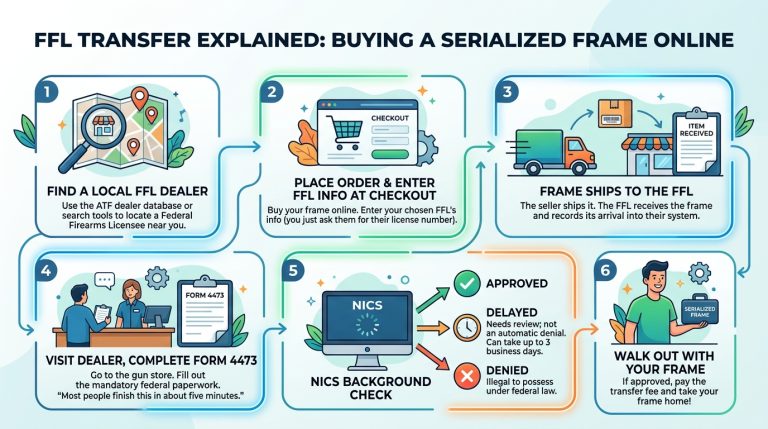
The frame ships from polymer80firearms.com to a licensed FFL dealer of your choice. You visit that dealer, complete a standard ATF Form 4473, pass a federal background check through the NICS system, and take possession of your frame — the same process as buying any handgun at a gun store. The slide, barrel, parts kit, and other components ship directly to your home, because those parts are not regulated as firearms.
This process removes the ambiguity that existed before 2022. There’s no grey area about whether you followed the rules — you completed a federal background check, the transaction is recorded, and you took possession of a serialized firearm through a licensed dealer. That’s full compliance by any reasonable measure.
State Laws: A Real Variable That Requires Your Attention
Federal law establishes the floor. State laws can go further, and in some cases they go significantly further.
Several states have enacted their own restrictions on pistol frames, specific configurations, or components that are fully legal under federal law. California, New York, New Jersey, Hawaii, and a handful of others fall into this category. Some states restrict magazine capacity. Others have specific requirements around serialization or registration of home builds that go beyond federal minimums.
polymer80firearms.com uses automated compliance tools to block sales to states where current law restricts these products. That’s a safeguard, not a substitute for your own due diligence. Laws change, and the responsibility for knowing your state’s specific requirements sits with the buyer — which is true of any firearm purchase, not just Polymer80 frames.
If you’re in a state with complex firearms laws and you’re not sure where something falls, a firearms attorney in your state can give you a clear answer in a short consultation. It’s worth the hour.
What You Need to Do Today to Stay Compliant
The good news is that the compliant path is also the simplest path. Here’s what it looks like when you buy through polymer80firearms.com:
Verify you’re eligible — You must be federally eligible to purchase a handgun. If you can legally buy a Glock at a gun store, you can legally purchase a serialized Polymer80 frame.
Confirm your state allows the purchase — Check that your state doesn’t have additional restrictions. The site’s compliance tools help here, but verify independently if you have any doubt.
Identify a local FFL dealer — Find a gun shop near you that accepts FFL transfers. Most do, typically for a modest fee. Have their FFL information ready before you complete your order.
Complete your order — The frame ships to your FFL. Parts and tools ship to your home.
Pick up your frame at the FFL — Complete the Form 4473, pass the background check, and take possession in person. You’re done.
That’s the whole process. It’s the same process millions of Americans go through every year when they buy a handgun. The Polymer80 frame is a regulated firearm sold through regulated channels. The build itself — assembling your parts kit onto the completed frame — is lawful personal use of a firearm you legally own.
The Bottom Line
Polymer80 frames purchased through polymer80firearms.com today are fully compliant, serialized firearms that go through the same federally regulated purchase process as any handgun. The confusion around legality largely comes from the pre-2022 landscape, which no longer reflects how these products are sold.
If you’re a responsible, federally eligible gun owner who wants to build a quality pistol, the legal path is well-marked and straightforward. Do your due diligence on your state’s specific laws, work with a licensed FFL dealer, and build with confidence.
Browse serialized, ATF-compliant Polymer80 frames and full build kits at polymer80firearms.com. All frame purchases require FFL transfer and federal background check. Questions about the purchase process? Our support team is available to walk you through it.